If reform was genuinely the objective, the government could have introduced a MGNREGA 2.0 or strengthened the existing framework. Choosing instead to discard Gandhi’s name altogether points less to administrative necessity and more to a deliberate political statement, one that alters the scheme’s identity.
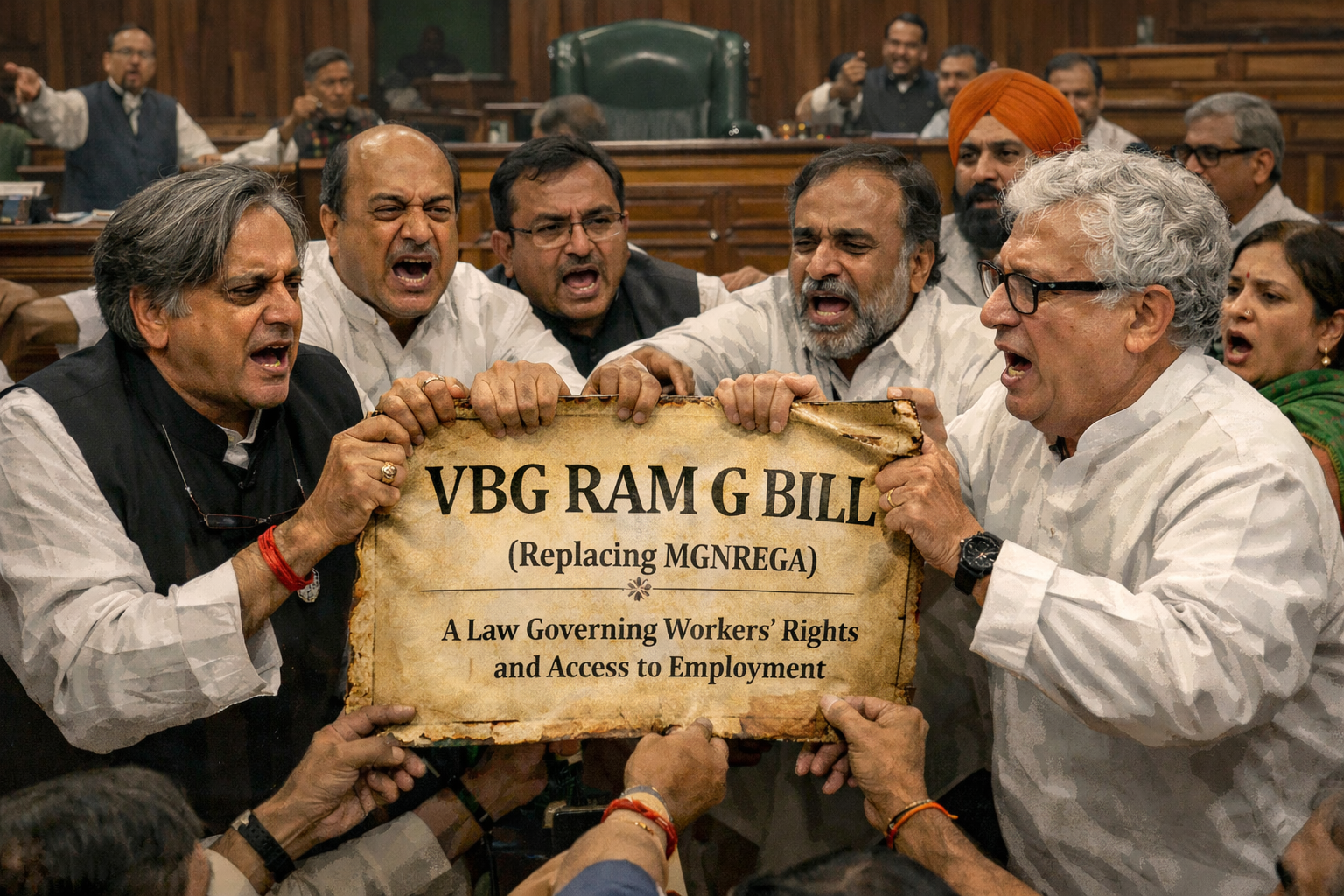
On December 18, barely three days after it was circulated, Parliament passed the Viksit Bharat Guarantee For Rozgar and Ajeevika Mission (Gramin) or VB-G RAM G Bill, replacing the Mahatma Gandhi National Rural Employment Guarantee Act, 2005. The speed of the passage triggered protests from the Opposition and civil society, both of which accused the government of bypassing consultations on a law that affects millions of rural workers. But procedure aside, the larger issue is more basic: why did MGNREGA need to be replaced at all?
Minister of Rural Development, Shivraj Singh Chouhan defended the Bill as a “more effective, corruption-free, development-oriented” employment guarantee. The government argues that rural India has changed dramatically since 2005. Poverty has declined, infrastructure has expanded, and digital governance has changed welfare- delivery. In this telling, MGNREGA’s demand-driven design belongs to another era.
Some changes do sound reasonable. The Bill increases guaranteed workdays from 100 to 125, potentially raising household income by roughly 25 per cent. It introduced a sharper focus on building long-term assets in four sectors: water security, core rural infrastructure, livelihoods and climate-resilient projects. Farmers are expected to benefit from smoother labour availability, as states can pause public works for up to 60 days during sowing and harvest periods.
The Bill also promises predictable employment through Viksit Gram Panchayat plans, secure electronic wage payments with Aadhaar verification and unemployment allowance if work is not provided. These changes are clearly designed to improve planning and asset creation.
Between 2013-14 and 2025-26, women’s participation rose from 48 per cent to 56.7 per cent, Aadhaar-seeded workers increased from 7.6 million to 12.1 million, and e-payments rose from 37 per cent to near-universal coverage. Geo-tagged assets grew from zero to 64.4 million and individual assets tracked from 17.6 per cent to 62.9 per cent. Yet, serious issues persisted. Investigations in 19 districts of West Bengal found fake and misused funds; monitoring across 23 states uncovered missing or substandard work, machine substitutions for labour, and bypassed attendance.
In 2024-25 alone, misappropriation reached nearly Rs 194 crore and only 7.6 per cent of households completed 100 days of work after the pandemic. Despite these challenges, MGNREGA’s demand-driven design remains its defining strength. It made employment a right rather than a favour. By guaranteeing wages and offering work on demand, it strengthened labour bargaining power and set a floor beneath rural wages. Its flexibility allowed it to act as a stabiliser during COVID-19, when it sustained rural consumption and prevented widespread distress. Fixing these operational gaps was possible without dismantling the programme’s core logic.
But the Opposition’s criticism goes much deeper than this process.
Shashi Tharoor and several other MPs argue that the Bill violates Article 348 of the Constitution by pushing a Hindi-dominant title for a law meant to apply uniformly across India. The sharper controversy, however, centred on the renaming itself. Opposition leaders pointed out that while Mahatma Gandhi used Ram Rajya to talk about value and good governance, but invoking “RAM” now brings ideology and religion into the picture.
Well, if reform was genuinely the objective, the government could have introduced a MGNREGA 2.0 or strengthened the existing framework. Choosing instead to discard Gandhi’s name altogether points less to administrative necessity and more to a deliberate political statement, one that alters the scheme’s identity.
There are also serious federal concerns. The revised funding model shifts part of the financial burden to states, which the Opposition describes as unfair and fiscally irresponsible. At a time when states are already stretched, this change weakens their ability to respond to genuine demand for employment.
Central assurances of 60:40 cost-sharing (90:10 for North-eastern and Himalayan states, and 100 per cent funding for UTs without legislatures) do little to assuage worries about reduced flexibility or local planning authority.
The Bill’s labour provisions are perhaps a departure from MGNREGA’s philosophy. The 60-day no-work provision is framed as a practical measure to ensure labour availability during peak agricultural seasons. But it is also a retreat from the principle of the state as an employer of last resort. Under MGNREGA, workers could demand work as a right. VB-G RAM G makes work conditional, planned and partially capped. While it promises higher workdays and better asset creation, it quietly treats worker’s bargaining power as a problem to be managed rather than a feature to be preserved.
The broader question then is not about reform; rural employment policy can and should evolve. The question is why dismantle a programme that functioned effectively as a safety net for millions for rural households. MGNREGA’s flaws were real, but they could have been addressed through better monitoring, planning and digital tools. The government’s own statistics show improvements over the past decade.
What VB G-RAM G introduces is more controlled. Until the government answers all questions clearly—why a replacement was necessary, why the open-ended demand-driven design could not be retained, and why Gandhi’s name was removed—these uneasy question around VB-G RAM G will persist. Not because reform is unwelcome, but because replacing a proven, rights-based safety net demands far stronger justification than what Parliament has received.