
Tag: GenZ Protest

  • Why Gen Z protests are shaking the world

    Why Gen Z protests are shaking the world

    This article has been published with: Why Gen Z protests are shaking the world

    Unlike their predecessors, Gen Z is not content with gradual change. They have grown up in a digital world where progress is instantaneous and transparency is expected. Their protests are organised online, powered by memes, videos and digital solidarity. The internet is not just their stage; it is their weapon.


    For years, the world watched the protests erupted from Hong Kong to Cairo marking 2019 as the so-called “year of protest.” But in 2025, a different kind of uprising has taken shape. This time, it is much younger, sharper, and more connected.

    From Nepal to Indonesia, the Philippines to Morocco and Madagascar, a restless generation has taken to the streets, transforming frustration into defiance. Experts are calling it the wave of ‘Gen Z protests,’ and it may redefine how dissent looks in the modern age.

    The sparks that ignite these protests differ from one country to another, yet the underlying fire is the same: anger over poor governance, inequality, corruption and a future that feels increasingly out of reach. In Nepal, the outrage began with a government-imposed social media ban that was quickly reversed, but not before triggering a nationwide reckoning. For a generation raised online, the ban was not just an attack on communication but a silencing of identity and expression.

    It became the final straw in a long history of corruption, nepotism, and political failure. Prime Minister Oli’s resignation soon followed, exposing a deep disillusionment among young Nepalis who feel their democracy has been hijacked by the elite.

    In Indonesia and the Philippines, the frustration runs parallel over widening inequality, soaring youth unemployment, and an economy that no longer guarantees dignity. Many young people are working multiple low-paying jobs, watching the promise of education dissolve into a market that no longer rewards effort.

    A recent World Bank update highlights that one in seven people in China and Indonesia is unemployed, and that much of the region’s job creation has shifted from factories to unstable service work. The ladder that once lifted millions into the middle class has started to crack.

    In Morocco, protests have flared up around social justice reforms and the state of public services. The country’s youth are furious that billions of dollars are being pushed into hosting the 2030 FIFA World Cup while healthcare, education, and transport systems remain broken. To them, it is not just about sports, it is about misplaced priorities.

    The glittering stadiums are being built on the back of neglect. The government’s vision of progress feels hollow when water shortages, unemployment and social inequality persist.

    Across the Indian ocean, in Madagascar, young protesters are demanding something even more basic: electricity and clean water. The island nation faces an ironic dilemma, while political elites make grand promises of development, ordinary families continue to suffer from erratic power cuts and unreliable water supplies, often left in darkness and neglect.

    What unites these different uprisings is not just ideology, but exhaustion, a generation that feels cheated by those who claim to lead them.

    Well, it’s quite clear that this generation does not want symbolic reforms or slow-moving promises. They want results they are visible.

    Unlike their predecessors, Gen Z is not content with gradual change. They have grown up in a digital world where progress is instantaneous and transparency is expected. Their protests are organised online, powered by memes, videos and digital solidarity. The internet is not just their stage; it is their weapon.

    Every government scandal, every instance of elite privilege, every broken promise becomes public within seconds.

    Older generations often dismiss this as performative outrage, but it is much deeper than that. For Gen Z, activism is survival. They are fighting for jobs, dignity and relevance in systems that continue to exclude them. Their rebellion is not simply about demanding reforms; it is about reclaiming agency in societies that ignore them.

    In many ways Gen Z protests of 2025 are not just reactions to crisis; they are reflections of a larger global fatigue. The world has been living through years of economic uncertainty, climate anxiety and political stagnation. For young people who have inherited these challenges, protest is not a choice it has become a necessity.

    What is happening in these parts of the world is not chaos, it is clarity. These protests reveal a generation that refuses to wait, one that demands accountability now, not later.

    Governments can either listen or continue to pretend that stability is the same as peace. But the truth is clear: this generation is no longer asking for permission to change the world, it is already doing it.
  • Nepal’s double uprising: Revolt and exodus

    Nepal’s double uprising: Revolt and exodus

    This article has been published with Nepal’s double uprising: Revolt and exodus

    Nepal is today at an inflection point. The Himalayan republic, long accustomed to political instability has rarely faced a moment this stark: the biggest youth revolt in its history colliding with the largest exodus of its people abroad. The first is noisy, combustible and impossible to ignore. The second is quieter, but no less devastating. Both are rebellions, different in form but identical in essence, against a state that has failed to deliver.

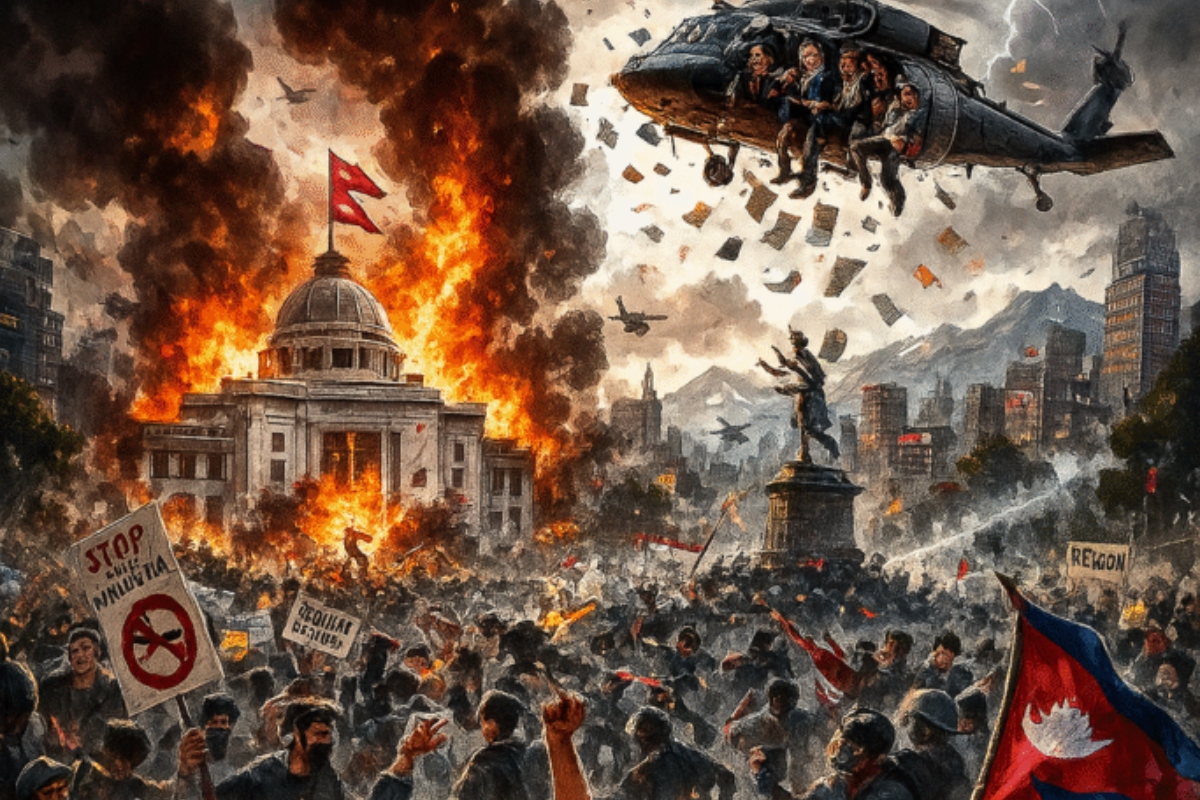
    The eruption of protests last month, triggered by a government ban on 26 social media platforms, was unlike anything Nepal has seen in decades. What began as an outrage over digital censorship spiralled into a generational uprising. Demonstrations spread across all 77 district capitals, claiming at least 19 lives in Kathmandu alone.

    Parliament and power centres burned, five former Prime Minister’s residences were vandalised, and Rajyalaxmi Chitrakar, wife of former PM Jhala Nath Khanal, died from severe burns after her house was torched. While Finance Minister Dhakal was stripped and paraded in public; Foreign Minister Deuba sustained injuries.

    This was not the palace intrigue of the past, nor the elite factional battles Nepalis have grown weary of. This was something more, a mass demand for accountable governance, credible constitutional reform and institutions that inspire trust. For Nepal’s Gen Z, the ban on TikTok or WhatsApp was merely the spark. The fire has been smouldering for years, fuelled by corruption, inequality and the absence of dignified work opportunities.

    A day after police opened fire on young demonstrators, Kathmandu was engulfed in flames. Prime Minister KP Sharma Oli resigned, and President Ram Chandra Paudel went into hiding under army protection.

    The ban on social media was hastily lifted, but the damage was already done. The youth of Nepal had issued their verdict: The system is broken and patience has run out.

    Yet, if the protest is a loud rebellion, migration is the quite one, perhaps even more telling. More than 4,00,000 Nepalis leave each year, an average of 10,000 departures a day. They hollow out the very demographic that should be building Nepal’s future, sustaining their families and the economy through remittances while abandoning the political order they no longer believe in.

    The absent, in effect, are financing a system they refuge to inhabit. World Bank report underlines this paradox—82 per cent of Nepal’s workforce remains trapped in informal employment, far above global and regional averages. For many, leaving is less of a choice than an act of survival.

    Nepal’s politics have long been a theatre of instability. Fourteen governments since 2008; none completing a full term. The Maoist insurgency of 1996 claimed 17,000 lives in its attempt to overthrow the monarchy. The 2008 abolition of the royal order was supposed to herald a people’s republic. The 2015 constitution was hailed as a landmark. And yet, KP Sharma Oli, a nationalist, populist, survivor, cycled in and out of office four times between 2015 and 2024 only to fall once again in 2025.

    The pattern is depressingly familiar, tactical manoeuvring among three dominant parties, the Nepali Congress, CPN-UML and the Maoist Centre at the expense of structural reform.

    Pushpa Kamal Dahal (Prachanda) continues his balancing act. Sher Bahadur Deuba struggles for relevance. Meanwhile, power circulates among the same aging elites, their children flaunting privilege on social media while ordinary citizens struggle with unemployment, rising costs, and climate vulnerability. The gap between rulers and ruled has become unbridgeable.

    For Gen Z, who have grown up on promises of democracy but experiences little of its substance, this political theatre has lost all legitimacy. “Nepobabies” trend online as shorthand for the dynastic impunity of Nepal’s political class. What matters to them is not ideology but the lived reality of jobs, dignity and opportunity, all of which are in short supply.

    This convergence of revolt and exodus is existential. A country that loses its youth either to martyrdom in the streets or to migration risks eroding its national security.

    The government’s use of excessive force did not just provoke fury; it confirmed suspicions that the system is corrupt, stagnant and unwilling to listen. The resignation of Oli only deepens the vacuum, inviting shifting alliances that promise more of the same paralysis.

    And here lies the danger, rebellion without reform hardens despair. If the protests fizzle into yet another cycle of unstable governments, while the exodus continues unabated, Nepal risks hollowing itself out.

    For India, Nepal’s turbulence is not a distant spectacle but a pressing concern. The movement of people and ideas across the border are too close to break. Instability in Nepal inevitably spills into Bihar, Uttar Pradesh, Sikkim and Uttarakhand. A large-scale exodus would intensify pressure that India is already struggling with, such as employment shortages, social friction and migration management.

    The fall of Oli bears uncomfortable parallels with Bangladesh last year, where the collapse of the Sheikh Hasina government left spaces for anti-India narratives to flourish. If New Delhi mishandles its engagement with Kathmandu, it risks a similar backlash. The stakes are stark, a neighbour either renewed or unravelled.

    India cannot dictate Nepal’s fate. But it can choose to engage wisely. That means listening not just to Kathmandu’s elites but to Nepal’s youth, who are demanding accountability, opportunity and dignity. It means demonstrating through aid, trade and people-to-people ties, that India hears Nepal’s young voices rather than ignoring them. And it means resisting the temptation to back shifting political alliances without regard for their democratic legitimacy.

    For Nepal, the way forward requires more than cosmetic changes. The constitution of 2015 must be reinvigorated with credible reforms that strengthen institutions and protect rights. Parties must rise above tactical rivalry and commit to structural transformation such as education reform, job creation, curbing corruption and making government transparent.

    For India, the imperative is to support Nepal’s democratic renewal, not its decay. This is not merely about geopolitics or China’s growing footprint in South Asia. It is about the recognition that when a Neighbour’s youth cry out in the streets or by leaving, it is a cry that reverberates across borders.

    Nepal today stands at a crossroads. If its leaders keep fighting among themselves while the youth either protest on the streets or leave the country, Nepal risks becoming a republic without a future. But if both the loud revolt and the quiet rebellion are taken seriously, the country still has a chance to rebuild itself.

    For India, the choice is just as clear, it can either watch a neighbour fall apart or engage in a way that gives Nepal’s youth a hope.

    The stakes are bigger than Nepal alone. Its repercussions will affect the neighbours too and they must act very carefully.