Tag: Palestine

  • Inside Trump’s Board of power                                                     

    Inside Trump’s Board of power                                                     

    This article has been published with : Inside Trump’s ‘board of power’

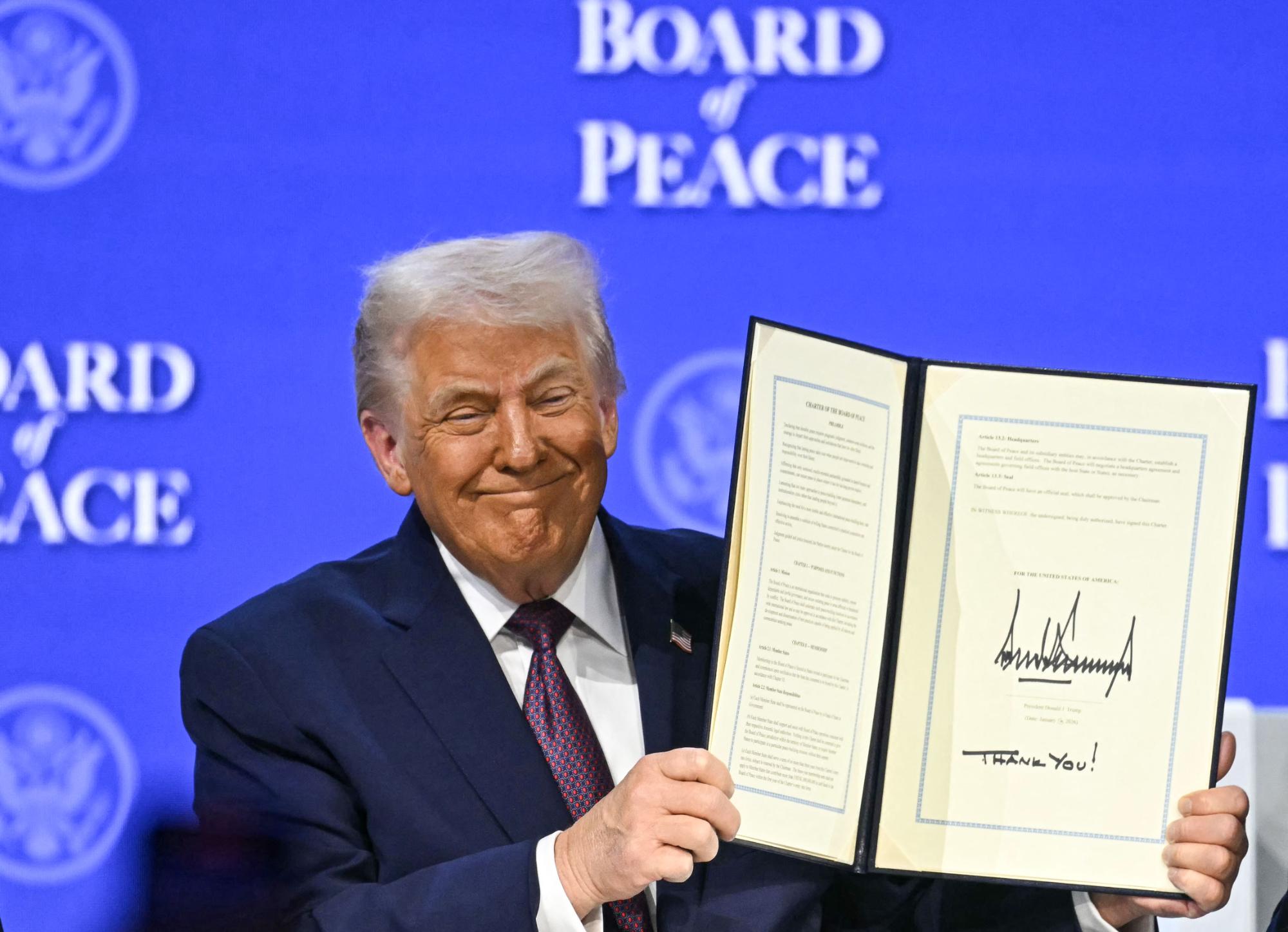
    The Board of Peace (BoP) is best understood not as a genuine multilateral initiative, but as a quasi-international body personally engineered by Donald Trump. While the United States initially sought UN backing for post-war plans in Gaza, the BoP’s final structure was unilaterally altered, hollowing out any claim to collective legitimacy.

    Crucially, the Board does not even explicitly mention Gaza, the very crisis it claims to address.

    This is not a small omission. Gaza was the moral and political justification for the initiative. Removing it from the formal mandate points toward a shift from humanitarian responsibility.

    Organisationally, the BoP departs sharply from accepted international norms. Trump has appointed himself chairman, while the executive board reportedly includes family members and close associates. More troubling is who is not represented: there is no Palestinian political leadership on the Board. 

    At best, a handful of Palestinian “technical experts” are included without any democratic mandate, and without recognition of the Palestinian people’s right to decide their own future.

    Perhaps the most disturbing inclusion is that of Benjamin Netanyahu, even as he faces serious allegations of committing acts of genocide.

    A peace forum that sidelines the victims while offering a seat at the table to those accused of grave crimes sends a clear message that ‘power speaks louder than justice’.

    Trump has defended the Board of Peace as an alternative to the United Nations, arguing that the UN is fractured, slow and ineffective. Many would agree that the UN has its flaws, but frustration with multilateralism does not justify abandoning it altogether.

    Creating a parallel international structure based on personal authority is not reform, it is replacement by force of influence.

    This move also fits a broader pattern. The US withdrawal from the World Health Organisation weakened global public health coordination. His great ‘MAGA’ ambitions now seem to undermine public health as well.

    Additionally, his disregard for the Paris agreement which jeopardises collective climate action. In each case, institutions were dismissed as unfair or inconvenient.

    Well, the Board of Peace follows the same logic; when global rules limit power, build a new table and decide who gets a seat.

    For Palestine, this is more than bad diplomacy, it is a betrayal of the very principles meant to protect stateless and occupied people. Decisions about governance, security and reconstruction are being shifted away from international law into a US-controlled forum where accountability at its helm remains absolutely vague.

    This brings us to India now. As India was among the 22 countries invited to join the Board of Peace, yet New Delhi chose not to attend the launch. That hesitation was not diplomatic indifference it was prudence.

    One immediate red flag is that Pakistan has already joined the Board, complicating India’s strategic position in a forum shaped largely by US preferences.

    India, with its diplomatic tradition rooted in strategic autonomy, non-alignment and respect for international law, has little to gain from joining such an ad-hoc and personalised initiative.

    A board tied so closely to one political figure’s authority and preferences lacks durability and credibility. It could easily lose relevance once Trump exist the political stage.

    Importantly, staying out does not mean disengagement. India has consistently supported Palestine through humanitarian aid, medical assistance, engagement with UNRWA, and quiet diplomacy via its office in Ramallah.

    India has previously resisted U.S.-led unilateral ventures. In 2003, the Vajpayee government declined Washington’s request to send Indian troops to Iraq, reaffirming that peacekeeping must be conducted only under the UN framework.

    Supporting Trump’s Board of Peace, would weaken India’s moral standing. Rather than endorsing it, New Delhi should press for its integration into the UN Department of Peace Operations ensuring a multilateral oversight, and accountability, in which Gaza is included.

  • India’s role in the new Gaza peace

    India’s role in the new Gaza peace

    The article has been published with: As the first phase of US president Donald Trump’s 20-point peace plan for Gaza gains traction, with both Hamas and Israel cautiously signing onto its initial framework, a new moment of reckoning arises not just for the region but for India, whose interests and ideals converge at the heart of Gaza’s fragile peace.


    As the first phase of US president Donald Trump’s 20-point peace plan for Gaza gains traction, with both Hamas and Israel cautiously signing onto its initial framework, a new moment of reckoning arises not just for the region but for India, whose interests and ideals converge at the heart of Gaza’s fragile peace.

    The plan, which emphasises large-scale international investment in water, energy, health, and infrastructure, has drawn careful support from the European Union and several Arab states, including Egypt, Qatar, Saudi Arabia, and the UAE.

    While many remain concerned over the absence of a clear timeline for Israel’s withdrawal, the momentum itself is significant. Prime Minister Modi welcomed the plan as “decisive progress” and a “significant step forward,” signaling India’s willingness to see stability return to Gaza after years of destruction and despair.

    For India, peace in Gaza is not an abstract moral issue but a question deeply linked to its historical diplomacy, energy security, and regional aspirations. New Delhi’s engagement with the Palestinian question predates its own independence.

    In 1947, Jawaharlal Nehru ensured India’s participation in the UN Special Committee on Palestine, where India defied the Western bloc to support a single federal state with Arab and Jewish provinces, a stance consistent with its postcolonial belief in coexistence and self-determination.

    In the following decades, India extended sustained financial support to the United Nations Relief and Works Agency for Palestine Refugees (UNRWA) and contributed troops to successive UN peacekeeping missions, including the UN Emergency Force in the Suez and Sinai, where Indian soldiers even lost their lives during the 1967 Arab-Israeli conflict.

    India’s solidarity with the Palestinian cause has never been merely symbolic. In 1988, it became one of the first non-Arab nations to recognise the State of Palestine, a step that many Western democracies only began contemplating decades later. Yet, the early 1990s marked a recalibration. When India established full diplomatic relations with Israel in 1992, it was not a repudiation of its commitment to Palestine but a response to the changing geopolitical order.

    The Madrid Peace Conference has brought new players to the table, and India, wary of being excluded from the evolving peace process, adjusted its strategy to engage with both sides. Since then, India has attended donor conferences, participated in UN committees on Palestinian rights, and provided development assistance and technical training to the Palestinian Authority (PA), while simultaneously building robust defence, agricultural, and technology partnerships with Israel.

    This dual approach, combining principled support for Palestinian sovereignty with pragmatic engagement with Israel, has been the defining feature of India’s Middle East policy for over three decades.

    India has repeatedly condemned terrorism in all its forms, including attacks on Israeli civilians, while also expressing concern when Israel’s military operations inflict civilian suffering in Gaza. Its response to the recent conflict, particularly after the airstrikes near Doha, was carefully worded but deliberate, reiterating the need to respect international humanitarian law and resume dialogue toward a two-state solution.

    At the heart of India’s interest in the new Gaza plan lies not just diplomacy but economics as well. With the Abraham Accords reshaping West Asia, India finds itself part of a new cooperative architecture that bridges both Israel and the Gulf.

    The India–Middle East–Europe Economic Corridor (IMEC), announced in 2023, exemplifies this shift, a project linking India’s ports to the Gulf, Israel, and onward to Europe through rail and maritime routes. Its success depends on regional stability.

    A peaceful Gaza, integrated into a broader framework of reconstruction and trade, directly serves India’s interests in securing energy supplies, ensuring uninterrupted trade flows, and maintaining safe conditions for over eight million Indians living and working in the Gulf region, whose remittances exceed $40 billion annually.

    Israel’s ambassador to India recently suggested that New Delhi should take an active role in Gaza’s reconstruction, citing India’s expertise in infrastructure, water management, and digital governance. Indian companies such as Larsen & Toubro and Tata Projects have already demonstrated their capacity to execute large-scale civil works across the Middle East.

    India’s engagement in the region would not only consolidate the nation’s image as a development partner but also reinforce its credentials as a responsible power capable of constructive mediation.

    Beyond economic calculations, India’s participation would resonate with its broader foreign policy doctrine, one that blends strategic autonomy with normative leadership. As a founding member of the Non-Aligned Movement, India has historically positioned itself as a bridge between the Global North and South.

    Today, that legacy continues through new minilateral groupings such as the I2U2 (India, Israel, UAE, United States), which promote cooperation in food, energy, and innovation. By constructively engaging in Gaza’s recovery while upholding Palestinian sovereignty, India can project itself as a moderating force that values peace without partisanship.

    However, the path ahead demands caution. Aligning too closely with the Israeli or American approach could alienate traditional Arab partners, especially those sensitive to Palestinian sovereignty.

    The challenge for India, therefore, is to sustain a credible middle course one that upholds humanitarian principles while remaining anchored in realpolitik.

    In Gaza’s fragile future, India’s role could go beyond financial assistance. Its record in peacekeeping, institution building, and capacity training makes it uniquely positioned to help restore basic governance, healthcare, and education systems.

    Indian NGOs and development agencies, working alongside UN bodies, could contribute to skill-building programmes that empower Palestinian youth and reduce dependence on aid.

    From Nehru’s moral idealism to Modi’s pragmatic outreach, India’s policy on Palestine and Israel has been marked by adaptation without abandonment. The new Gaza peace plan presents yet another test of that balance.

    Whether India chooses to remain a cautious observer or an active participant in reconstruction will reveal how it defines power in the twenty-first century.