Tag: politics

  • The populist America needs today

    The populist America needs today

    This article has been published with: The populist America needs today


    It’s not every day that a Muslim of Indian origin becomes the mayor of the world’s richest city—New York. But today, Zohran Mamdani, born in Uganda to Indian parents, raised in Queens and long seen as an outsider in American politics, pulled off what many called impossible.

    In a city built by immigrants but ruled by elites, a man who once rapped about inequality and later worked as a tenant organiser fighting evictions now holds keys to the city hall.

    Mamdani’s victory isn’t just his own. It’s a mirror held up to America, a country still wrestling with what it means to be “American.”

    In a political landscape fractured by polarisation between the populist right and an exhausted liberal establishment, Mamdani has found resonance by talking about something both sides often forget, the cost of living. His promises of free bus rides, rent freezes, public grocery stores, and universal childcare sound almost utopian to his critics, but to many ordinary New Yorkers burdened by rent hikes and long commutes, they ring as necessary, even overdue.

    For nearly a decade, political populism in the United States has worn a single face that of Donald Trump. His “America first” rhetoric, nationalist nostalgia, and resentment-driven movement have defined one half of the nation’s mood. But Mamdani’s win represents a very different kind of populism—one built not on fear and exclusion, but on empathy and inclusion.

    Mamdani’s campaign wasn’t about identity politics, though identity was impossible to ignore. His very presence challenged the unspoken hierarchies of American powers. Yet, what propelled him wasn’t his biography, but his politics; one of survival.

    One tells his followers that they have been robbed by outsiders, the other tells his voters that they have been forgotten by insiders. It is a subtle but radical difference, the shift from populism as protectionism to populism as participation.

    That Mamdani openly identifies himself as a Democratic Socialist would have seemed unthinkable in the America of even a decade ago. Yet it reflects the slow transformation of political imagination among young voters who came at age through crisis like 9/11, 2008 financial crash and the pandemic each, chipping away at the myth that capitalism alone guarantees freedom.

    Mamdani has revived socialism not as an imported ideology, but as an American inheritance rooted in the labour struggles, anti-war movements, and civil rights campaigns that have long coexisted with capitalism’s glare.

    Still, his rise has unsettled many in the party. Centrists fear that his identity and socialist economics will be used by Trumpist to stoke old cultural divides ahead of the 2026 midterms. Yet the left within the party sees Mamdani what the Democrats have long lacked; moral clarity.

    He talks not about “unity” as a slogan but about justice as a material condition. His message of affordability and inclusion gives populism back its original democratic meaning.

    In that sense, Mamdani’s victory is less a footnote in New York’s political history than a window into America’s ideological future. It suggests that populism need not always carry the smell of nationalism. It can instead, be the language of a new social contract, one that redefines “the people” not by who they exclude, but by what they endure together.

    The MAGA movement made anger the grammar of American politics. Mamdani’s populism makes solidarity it’s syntax. Both claim to speak for “the forgotten,” but only one seeks to ensure that no one is forgotten again.
  • Will Ladakh demands finally be met?

    Will Ladakh demands finally be met?

    This article has been published with: Will Ladakh’s demands finally be met?

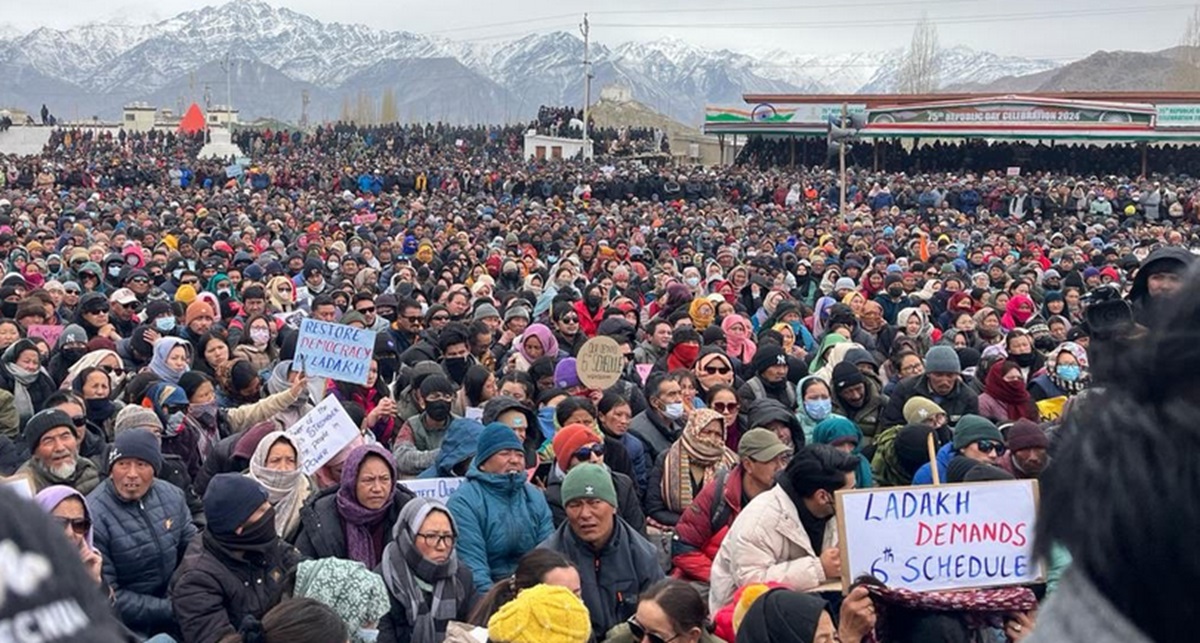
    Ladakh is simmering, and the latest violence has brought long-standing frustrations to a head. Four people have been killed, at least 50 injured and a community once known for it’s peaceful strikes now find itself in the eye of a storm.

    Well, the spark is clear: demands for statehood and the extension of Sixth Schedule protections, issues that go beyond politics and strike at the heart of identity, autonomy, and democracy in this fragile Himalayan region.

    Climate activist Sonam Wangchuck, who had been on a hunger strike for 35 days in solidarity with Ladakhi’s demands, called off his fast amid escalating tensions. The unrest erupted just days before talks were scheduled between the Centre and the Leh Apex Body on October 6, after a four-month haitus, with reports suggesting that Wangchuck was deliberately sidelined, seen as a stumbling block by the authorities. One might wonder, is there a better way to bridge communication gaps in such sensitive negotiations?

    Frustration runs deep. Locals feel promises made in previous elections have gathered dust, and with national elections looming, patience has worn thin.

    The roots of Ladakh’s unrest lie in a democratic deficit. When Article 370 was abrogated in 2019, Jammu and Kashmir retained a legislative assembly but Ladakh was left without any local governing body. Control over land and other powers was stripped away, leaving residents voiceless  in matters that affect their daily lives. This is not mere political tussle; it is a fight for recognition, representation and survival.

    The demands being voiced are measured, residents seek recognition by including the territory under Sixth Schedule that confers judicial, legislative and executive powers similar to those enjoyed in the north-eastern regions of Mizoram, Meghalaya, Tripura and Assam. Additional requests include job reservations for locals and an increase to two parliamentary seats to ensure regional perspectives are represented at the national level.

    These are not demands for special treatment, but a call for balanced governance and equitable representation. But at the same time, it begs the question, how can such aspirations be harmonised with wiser administrative and strategic considerations.

    Well, the government has taken steps in response. Measures include 85% job reservations for local, one-third of seats in hill development councils reserved for women, and the formation of a high-powered committee under the Ministry of Home Affairs to engage with leaders from both Leh and Kargil. Yet, challenges remain with the path forward requiring careful navigation.

    However, several factors make resolution a nuanced endeavour. Constitutional and legal complexities exist, given the distinct religious, cultural and economic interests of Leh and Kargil. Implementation gaps and limited clarity in administrative mechanisms can slow outcomes, and the strategic location of Ladakh, bordering China and Pakistan adds layers of national security considerations as well.

    Economic implications too, are tangible: tourism, a key source of revenue, could face disruption, with effects on regional and national GDP. Beyond economics, the question of cultural preservation remains central as well: how can infrastructure and development be planned so that heritage, language and traditions of the region are respected.

    Yet, what stands out in this situation is the continued commitment to dialogue and peaceful engagement. Patience has been a recurring theme, even in the face of prolonged uncertainty. And with any situation where expectations meet reality, tensions inevitably rise. This makes structured engagement, thoughtful negotiation and clarity of intent more important than ever.

    The situation calls for measured steps, informed dialogue, and a shared vision for the region’s development. These considerations strike at the core of democratic practice in regions with unique histories and geographies.

    But the answer to whether Ladakh’s demands will finally be met remains uncertain.

    The coming weeks will be crucial in determining if trust gets rebuilt. The real challenge lies in proving whether considered steps can strengthen both local representation and national cohesion, while upholding what India is built upon, “unity in diversity.” Until then, it remains a story one of simmering protests, promises and a long watchful wait of a region yearning for clarity.