Tag: United Nations

  • India’s role in the new Gaza peace

    India’s role in the new Gaza peace

    The article has been published with: As the first phase of US president Donald Trump’s 20-point peace plan for Gaza gains traction, with both Hamas and Israel cautiously signing onto its initial framework, a new moment of reckoning arises not just for the region but for India, whose interests and ideals converge at the heart of Gaza’s fragile peace.


    As the first phase of US president Donald Trump’s 20-point peace plan for Gaza gains traction, with both Hamas and Israel cautiously signing onto its initial framework, a new moment of reckoning arises not just for the region but for India, whose interests and ideals converge at the heart of Gaza’s fragile peace.

    The plan, which emphasises large-scale international investment in water, energy, health, and infrastructure, has drawn careful support from the European Union and several Arab states, including Egypt, Qatar, Saudi Arabia, and the UAE.

    While many remain concerned over the absence of a clear timeline for Israel’s withdrawal, the momentum itself is significant. Prime Minister Modi welcomed the plan as “decisive progress” and a “significant step forward,” signaling India’s willingness to see stability return to Gaza after years of destruction and despair.

    For India, peace in Gaza is not an abstract moral issue but a question deeply linked to its historical diplomacy, energy security, and regional aspirations. New Delhi’s engagement with the Palestinian question predates its own independence.

    In 1947, Jawaharlal Nehru ensured India’s participation in the UN Special Committee on Palestine, where India defied the Western bloc to support a single federal state with Arab and Jewish provinces, a stance consistent with its postcolonial belief in coexistence and self-determination.

    In the following decades, India extended sustained financial support to the United Nations Relief and Works Agency for Palestine Refugees (UNRWA) and contributed troops to successive UN peacekeeping missions, including the UN Emergency Force in the Suez and Sinai, where Indian soldiers even lost their lives during the 1967 Arab-Israeli conflict.

    India’s solidarity with the Palestinian cause has never been merely symbolic. In 1988, it became one of the first non-Arab nations to recognise the State of Palestine, a step that many Western democracies only began contemplating decades later. Yet, the early 1990s marked a recalibration. When India established full diplomatic relations with Israel in 1992, it was not a repudiation of its commitment to Palestine but a response to the changing geopolitical order.

    The Madrid Peace Conference has brought new players to the table, and India, wary of being excluded from the evolving peace process, adjusted its strategy to engage with both sides. Since then, India has attended donor conferences, participated in UN committees on Palestinian rights, and provided development assistance and technical training to the Palestinian Authority (PA), while simultaneously building robust defence, agricultural, and technology partnerships with Israel.

    This dual approach, combining principled support for Palestinian sovereignty with pragmatic engagement with Israel, has been the defining feature of India’s Middle East policy for over three decades.

    India has repeatedly condemned terrorism in all its forms, including attacks on Israeli civilians, while also expressing concern when Israel’s military operations inflict civilian suffering in Gaza. Its response to the recent conflict, particularly after the airstrikes near Doha, was carefully worded but deliberate, reiterating the need to respect international humanitarian law and resume dialogue toward a two-state solution.

    At the heart of India’s interest in the new Gaza plan lies not just diplomacy but economics as well. With the Abraham Accords reshaping West Asia, India finds itself part of a new cooperative architecture that bridges both Israel and the Gulf.

    The India–Middle East–Europe Economic Corridor (IMEC), announced in 2023, exemplifies this shift, a project linking India’s ports to the Gulf, Israel, and onward to Europe through rail and maritime routes. Its success depends on regional stability.

    A peaceful Gaza, integrated into a broader framework of reconstruction and trade, directly serves India’s interests in securing energy supplies, ensuring uninterrupted trade flows, and maintaining safe conditions for over eight million Indians living and working in the Gulf region, whose remittances exceed $40 billion annually.

    Israel’s ambassador to India recently suggested that New Delhi should take an active role in Gaza’s reconstruction, citing India’s expertise in infrastructure, water management, and digital governance. Indian companies such as Larsen & Toubro and Tata Projects have already demonstrated their capacity to execute large-scale civil works across the Middle East.

    India’s engagement in the region would not only consolidate the nation’s image as a development partner but also reinforce its credentials as a responsible power capable of constructive mediation.

    Beyond economic calculations, India’s participation would resonate with its broader foreign policy doctrine, one that blends strategic autonomy with normative leadership. As a founding member of the Non-Aligned Movement, India has historically positioned itself as a bridge between the Global North and South.

    Today, that legacy continues through new minilateral groupings such as the I2U2 (India, Israel, UAE, United States), which promote cooperation in food, energy, and innovation. By constructively engaging in Gaza’s recovery while upholding Palestinian sovereignty, India can project itself as a moderating force that values peace without partisanship.

    However, the path ahead demands caution. Aligning too closely with the Israeli or American approach could alienate traditional Arab partners, especially those sensitive to Palestinian sovereignty.

    The challenge for India, therefore, is to sustain a credible middle course one that upholds humanitarian principles while remaining anchored in realpolitik.

    In Gaza’s fragile future, India’s role could go beyond financial assistance. Its record in peacekeeping, institution building, and capacity training makes it uniquely positioned to help restore basic governance, healthcare, and education systems.

    Indian NGOs and development agencies, working alongside UN bodies, could contribute to skill-building programmes that empower Palestinian youth and reduce dependence on aid.

    From Nehru’s moral idealism to Modi’s pragmatic outreach, India’s policy on Palestine and Israel has been marked by adaptation without abandonment. The new Gaza peace plan presents yet another test of that balance.

    Whether India chooses to remain a cautious observer or an active participant in reconstruction will reveal how it defines power in the twenty-first century.
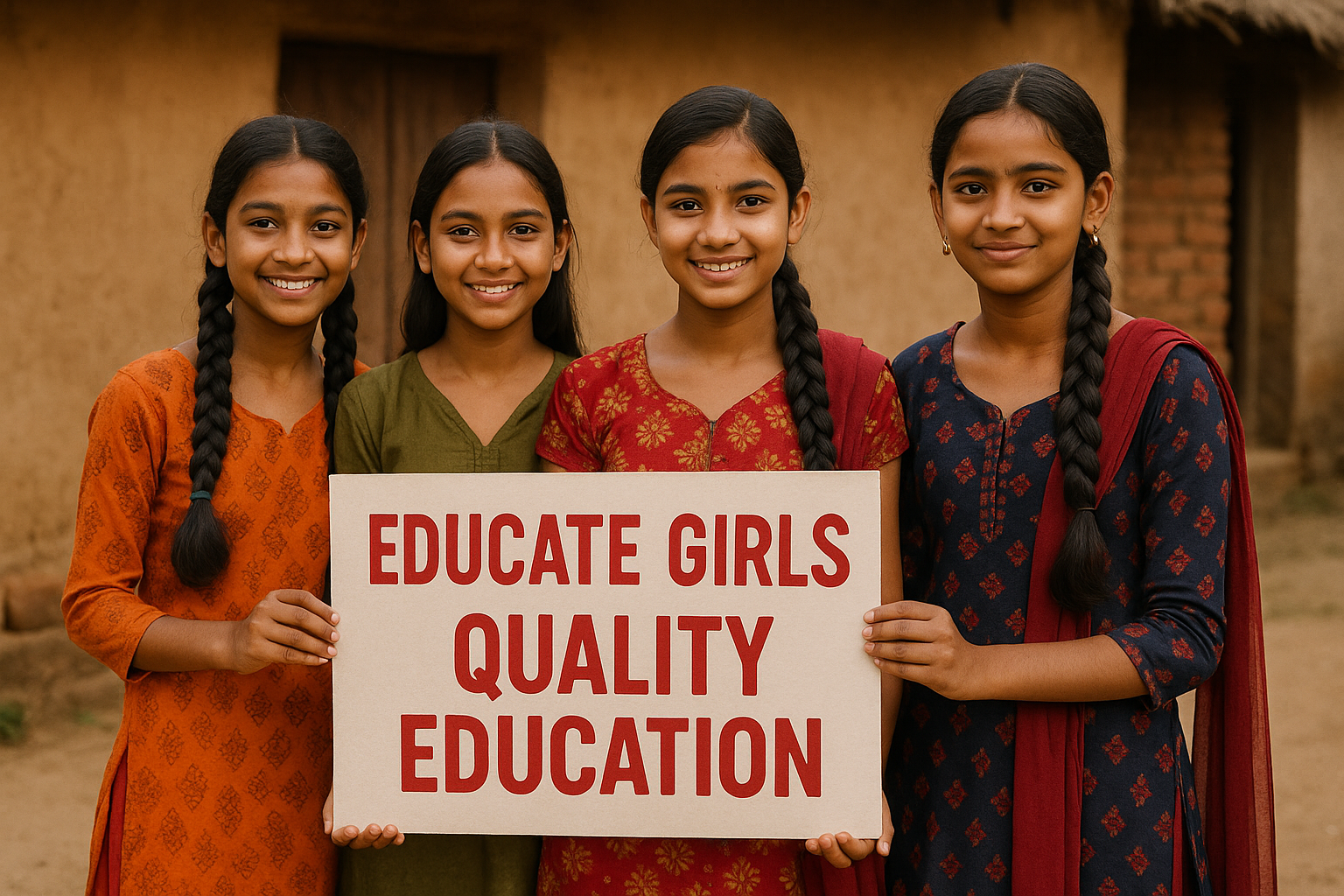
  • India’s silent education revolution finds its voice                       

    India’s silent education revolution finds its voice                       

    Asia’s most prestigious public service honor, Ramon Magsaysay Award, has this year been conferred on “Educate Girls,” an Indian non-profit that has brought millions of out-of-school girls back into classrooms. The recognition stands both as celebration of achievement and as a symbol of aspiration.  

    For the first time, an Indian organisation and one dedicated solely to girl’s education has received this prestigious honour. The award not only highlights how far India has come in transforming the lives of millions of girls through education, but also serves as a reminder of the long journey that still lies ahead before this silent revolution reaches its full promise.

    From a time when literacy among girls was an exception, India now has near-universal enrolment at the primary level, gender parity in early schooling, and the foundations of a society that is increasingly recognising the right of every girl to study.

    India’s education system today is among the largest in the world, with 250 million children enrolled in schools. Yet many girls drop out due to poverty, patriarchy, household chores, early marriage, lack of nearby schools, and sometimes due to basic barriers such as absence of toilets. Addressing these last-mile challenges will decide whether India’s educational revolution matures into a lasting transformation.

    To deny a girl education is not just injustice, it is a self-inflicted wound.

    The organization “Educate Girls,” founded by Safeena Hussain, began with just 50 villages in Rajasthan and today, it operates in more than 30,000 villages, having mobilised over 1.4 million girls into schools.

    The organisation’s genius lies not just in advocacy, but in architecture as well. Team Balika, an army of 20,000 community volunteers works door-to-door, persuading families, negotiating with local authorities, and hand-holding children back into classrooms. This blending of grassroot energy with systemic reform has made the model durable and scalable. Hussain’s earlier recognition with the WISE Prize, and now the Magsaysay, underline that India’s innovation in education resonates across the globe. As “Educate Girl’s” chair Ujwal Thakur puts it, “This is not charity or welfare, but the most powerful investment in the nation’s future.”

    Well, this story of change is not of civil society alone. The Indian state has laid strong foundations for this educational transformation. The Right to Education Act, made schooling a constitutional guarantee. Samagra Shiksha integrated quality, equity, and access into one umbrella scheme.

    Kasturba Gandhi Balika Vidyalayas created safe residential schools for marginalised girls. Beti Bachao Beti Padhao shifted the national imagination about the value of the girl child. States, too, innovated, like the Bihar’s bicycle scheme became a symbol of adolescent girls mobility and confidence, reducing dropouts and inspiring replicas across India. These interventions, combined with grassroot efforts, have pushed the revolution forward.

    It is worth remembering that this is the fulfilment of a vision long articulated by Indian reformers. Savitribai Phule, the country’s first woman teacher, defied caste and gender prejudice to open schools for girls in the 19th century. Her husband, Jyotirao Phule, fought alongside her to expand education as a right of the oppressed. Rabindranath Tagore saw learning as liberation of the mind, while Mahatma Gandhi and B.R. Ambedkar regarded education as the pathway to equality and justice.

    In more recent times, Amartya Sen has persuasively argued that women’s education is not just a moral imperative but a developmental multiplier.

    Today’s progress is attribute to these thinkers and to the ordinary teachers. Volunteers, and families who are carrying their legacy forward.

    The dividends are quite visible. Each year of secondary schooling delays early marriage, improves mental health, and boosts lifetime earnings. The World Bank estimates that every girl in India completed 12 years of schooling, the GDP could grow nearly 10% within a decade. Girls’ education has ripple effects across health, productivity and democracy itself.

    When given the chance to study, rural girls often break cycles of poverty and challenge deep-rooted stereotypes. Their education becomes a multiplier. Anita Gupta from Bihar, born to a family of daily wage labourers, studied under streetlights because her home had no electricity. Her determination earned her scholarship and a place at the UN Youth forum.

    These journeys show that rural girls are not passive benefeciaries but active changemakers.

    The challenge now is to sustain momentum and extend gains. Rural India still sees the widest gender gaps, with millions of young women having dropped out between the ages of 15 and 30. Educate Girls’ PRAGATI programme, which reintroduces adolescent girls to learning through camps and open-school exams, shows how to plug this gap. Expanding Kasturba Gandhi Balika Vidaylayas up to Class 12, ensuring universal access to safe transport, and prioritising foundational literacy by Grade 3 are critical next steps. Most importantly, India must move beyond enrolment as a metric, and make completion and learning outcomes the new benchmarks of success.

    Globally, there are lessons to borrow. Bangladesh tied stipends to attendance and delayed marriage, keeping adolescent girls in school. Vietnam invested heavily in rural schools and achieved near-universal lower secondary completion. Whereas, Indonesia focused on safe transport and teacher training. India, with its scale and experience, is positioned not just to catch up but to lead, provided it sharpens its focus on secondary education, harnesses technology and data to track progress.

    The Ramon Magsaysay Award for Educate Girls is a recognition of what India has achieved, but also a reminder of what remains unfinished. The fact that millions of girls today step into classrooms who once would have been denied even the chance is itself a revolution. However, the true measure of success will not be the enrolment figures we celebrate, there must be expansion of secondary schooling, securing their safety, tackling rural dropouts, and ensuring that learning outcomes match enrolment gains.

    The revolution must continue in classrooms, in villages, in policies, and in the hearts of families who choose to send their daughters to school.

    The next leap will come from treating these not as isolated successes but as non-negotiable rights guaranteed to every girl child.